

How Did The Industry Get Into This Mess?
And no, it's not your fault you're struggling to find a new role.

The Glory Days.
In 2012, I was a mediocre coder who’d never written a SQL query. Companies flew me to San Francisco and fought over me. In 2024, engineers with 10 years of experience can’t get a callback. WTF happened?
I graduated college into the tech industry in 2012. At this point, I already had a resume that I was fairly proud of:
1 year part-time role doing QA at Cakewalk, makers of Sonar (the first commercially available MIDI DAW)
6 month internship at RIM (Blackberry, for you zoomers. It was like an iPhone but had a keyboard. And you could play brickbreaker on it. Leave me alone.)
6 month part-time job at MIT HAL Lab.
Contributions to the Java Music Specification Language
Some pretty cool hackathon projects that got a decent amount of attention
Head of Technology Programming for Boston’s Together Festival
Despite the fact that I was a pretty mediocre coder, my resume got me in the door for quite a few interviews. I spent a week running around San Francisco from startup to startup, until settling on a role at a Songbird, whose wings were clipped one month after my start date.
So here I was, a “passable” coder who had never even written a SQL query or pushed any code to a web environment, getting flooded with interviews. They even covered my hotel and airfare.
Ask anyone who was there and they will tell you that these were the glory days of tech. Investors were throwing money all over the valley. Lavish tone-deaf parties with caviar and champagne, corporate events with confusingly big musical acts, and offices that more closely resembled a Dave & Busters than a place of work. Not to mention the glut of tech bros buying expensive cars because they deserved them, definitely not because they felt insecure or anything.

Things were pretty ridiculous in those days. The credit card points I earned from buying kegs and cases of beer for my employer’s weekly All Hands meetings covered two round trip tickets to Japan for my honeymoon. A friend of mine quit his job after raising a pre-seed round, which he then used to pay his rent and keep a never-ending supply of shisha in his Cupertino apartment.
Oh yea and I guess we got some work done, sometimes.
Over time, the looming expectations of investors dangled like that prophetic sword of Damocles. Companies realized they needed to hit that 10x, hockey-stick growth. Hiring needed to pick up, but there was a problem- nobody really knew how to do it.
There was a time when these companies had ideas and dreams, but little tech. And in order to scale, they hired a handful of industry stalwarts, and surrounded them by young idealistic coders who double fisted red bulls and pax plumes. The test was pretty simple- can you build? If not, get lost.
But now these companies were bigger, and quality control was harder. The path forward was less obvious- dozens of teams sprouted up to try out new initiatives. Public APIs were all the rage, mobile app strategies were shifting, and applied machine learning was still an amorphous goal.
Enter the 90 Day Interview.
With investors breathing down their necks, and hiring being an expensive process (this was before zoom calls were common place), companies started embracing the 90 day interview.
If you google “90 day interview”, you’re going to come up dry. It’s not an official thing, but pretty much every company does this. They hire you, and then give you a “30-60-90” plan outlining goals you are expected to hit on those timelines. At the end of your first 90 days, they give you a review. If you aren’t meeting the bar, you’re exited.
This is a very appealing way to bring on employees. You can hire en masse- we used to see onboarding days once or twice a month with anywhere from 30 to 100 new employees. The best employees were kept, the rest were shuffled off. It might sound like a waste of time and money (it is), but from a company’s perspective, this was a land grab. It not only made them a “go to” for new college grads, but it meant they had the highest chance of getting the top 10% before their competitors did.
The impact on employees was rough. The most junior engineers were tasked with onboarding and training the even-more-junior newbies. They were given no training in mentorship, so not only were they failing to deliver value to the new employees (which wasn’t the goal- they were here to be assessed, not trained), but they also were now failing to deliver on the job they were hired to do.
This created an “up or out” mentality. If junior engineers could get out of this rat race and become important enough to avoid the overwhelming task of herding in new employees like cattle, they would be able to protect their time and deliver. If not, they would likely never succeed at their goals, receive sub-par reviews, and then move on to the next company (likely next door, or even in the same building).
Good thing there wasn’t an entire industry built around worsening this situation. Oh wait, there was.
The Bootcamp Problem.
It was around this time in the early 2010’s that MOOCs and bootcamps exploded. As the “Retail Apocalypse” and rapid decline of print media hit the US there were scores of job seekers looking for greener pastures. With promises of easy to obtain roles, high salaries, and ridiculous perks, career changers flocked to tech like a Furby display on Black Friday. If you don’t get that reference, don’t @ me- I already feel old enough.
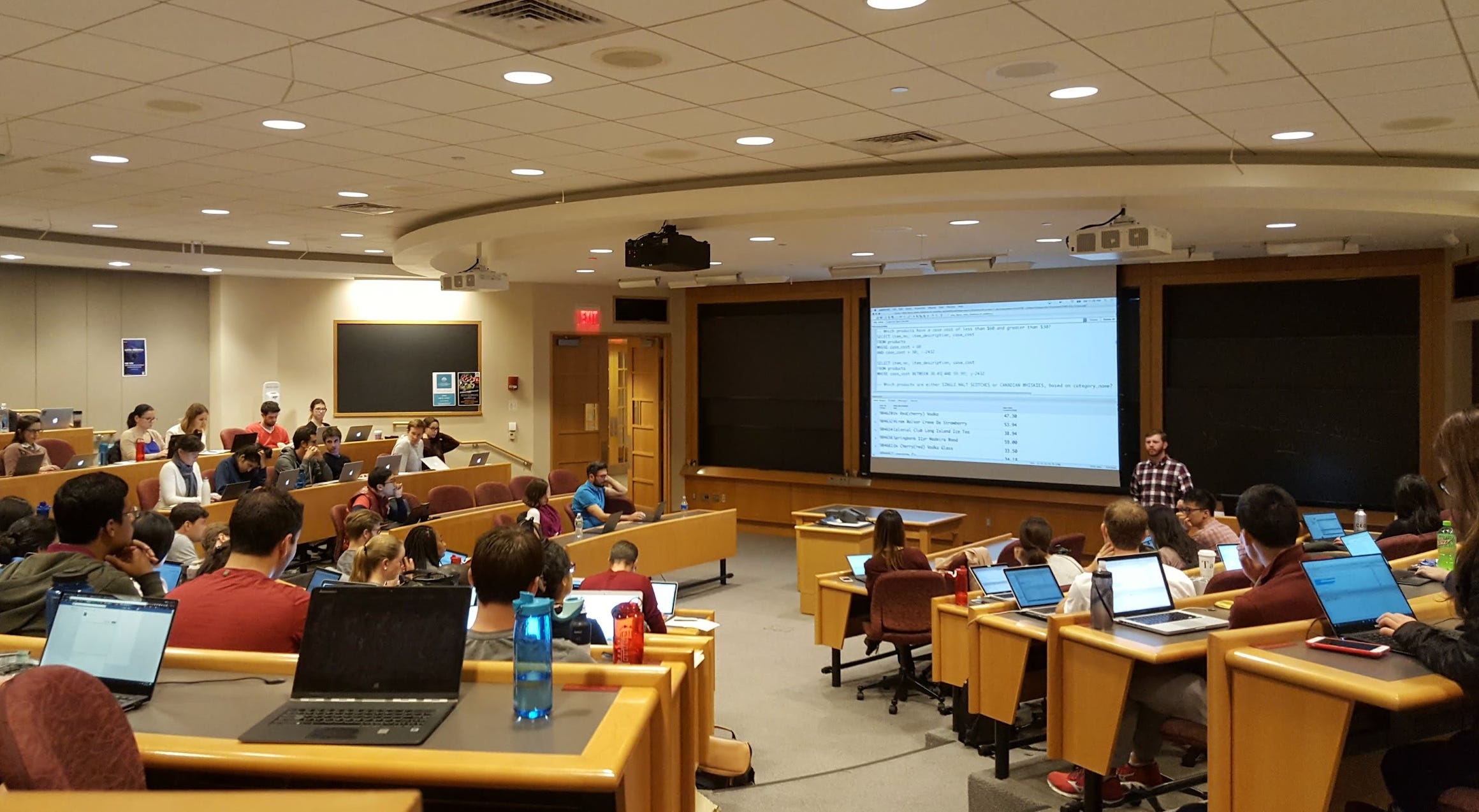
Note: From 2014-2020 I was an instructor, curriculum designer, and consultant for one of the industry leading engineering bootcamps. This experience changed a lot of lives- mine included. Not everything is black and white- it’s a complex topic.
I’m not here to demonize non-collegiate education tracks. The education system in America has failed us all. And these avenues of technical learning are a blessing to people from underrepresented groups and public school systems that barely had working PCs. And at first, the bootcamp that I worked at part time did a really good job of filtering out anyone who didn’t have a high likelihood of making it in tech. But over time these programs were hit by “Hockey Stick Scaling” fever and would bring in anyone with a pulse, offering scholarships and loans and employment guarantees that typically ended in the bootcamp themselves hiring their graduates as “teaching fellows”.
This made everything worse.
Most instructors weren’t currently employed as SWEs. Most HQ staff had never worked in tech. The instructors weren’t making their own curriculum, it was all cookie cutter.
The result was thousands and thousands of bootcamp grads with nearly indistinguishable resumes. For some reason, they were told to remove any notion of a prior career. They had the same portfolio projects, the same resumes, the same everything. The result was tens of thousands of bootcamp grads with nearly indistinguishable resumes. Through no fault of their own, they’d been given identical portfolio projects, identical resume templates, and advised to erase their prior careers. The individuality that makes someone hirable had been systematically removed.
This made it even harder to use resume review and interviews to filter out the cruft. So the 90 day interview became even more popular. Bring in as many people as possible, find the diamond in the rough, and do away with the rest.
Companies started “apprenticeship” programs, marketed as 90 day onboarding programs. They weren’t always clear about the subtext- after those 90 days, if you weren’t cutting it, you would be let go. Hell, sometimes you were just told “there aren’t enough spaces on teams” and were let go anyway. I personally watched H1B visa holders shift into new roles and then face deportation when they were shown the door. The human cost of this process is indisputable.
And Then The VC Money Dried Up.
In 2020, we all know what happened. COVID, lockdowns, wars. We were already dealing with the fallout of the first season of Bozo Goes To Washington and things just kept getting worse. Investors stopped writing blank checks- and when they came to ask where their investments went, they were met with blank stares.
So hiring froze. Layoffs became a new way of life. And it’s not just engineers- when hiring freezes, we lose recruiters, HR, office staff, etc. Entire companies were decimated, flooding the already saturated market. The bubble had burst.
Enter AI.
AI does a lot of things really well. After all, it’s really just Machine Learning rebranded. Generative AI, however, causes a lot of issues. A paper released in November of 2025 outlines the difficulty that LLM derived written word presents in determining hiring signals:
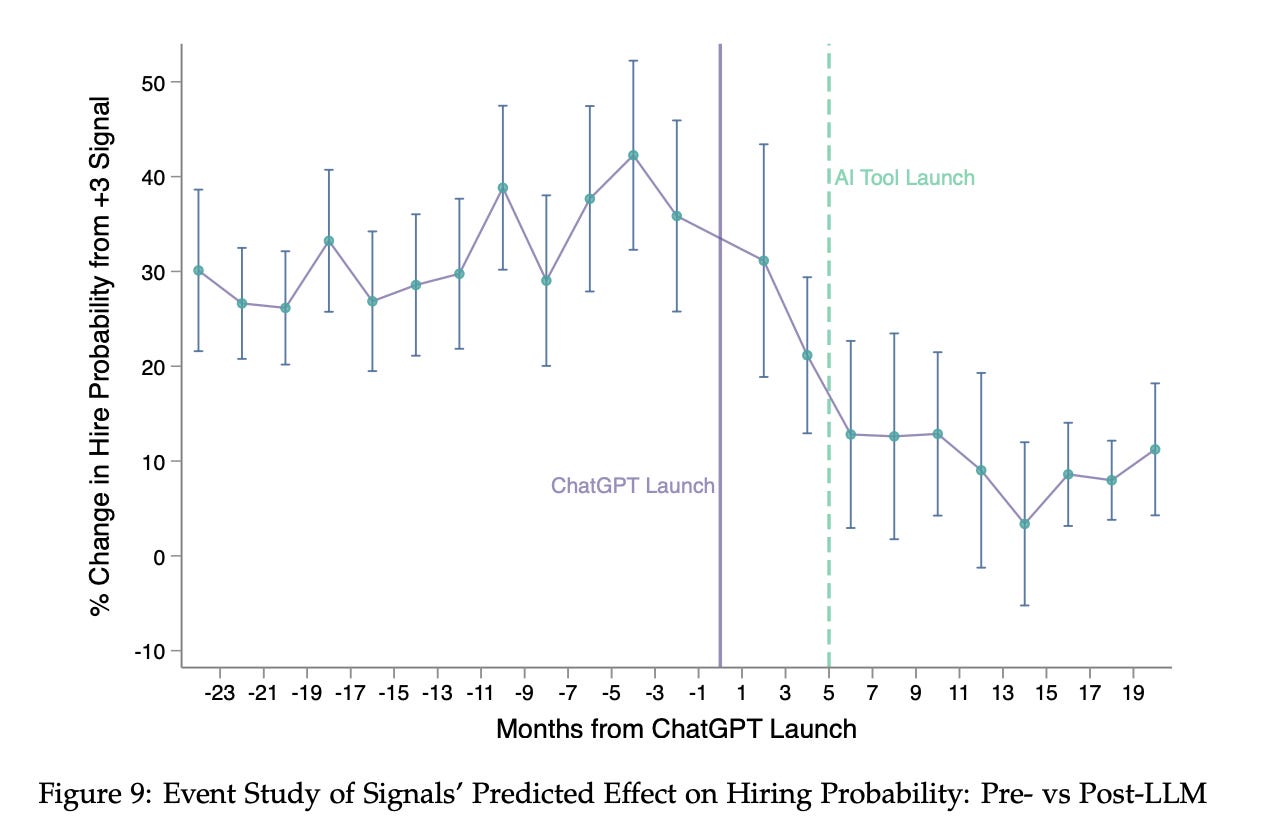
This figure provides evidence that employers begin to adjust their beliefs about signals shortly after the release of ChatGPT, and that these beliefs adjust downwards even further after the platform’s AI-writing tool is introduced.
In plain English, generative AI tools remove almost all ability to leverage written word as a signifier of job fit. So your resume, cover letter, LinkedIn profile, and any written communication, is effectively useless. That’s a significant portion of the interview process, and the key means of filtering.
The prevailing belief in team building was that “Hire Slow, Fire Fast” was the best approach. As I like to put it-
The most important thing you can do in building a company is put as much time and effort as possible into hiring. If you do that right, everything else becomes incredibly fucking easy. — Robby Grodin (that’s me)
But when the Level Of Effort and Return On Investment curve flips, that time because essentially wasted. And that’s how we’ve entered the era of ”Hire Fast, Fire Faster”.
So next time your parents complain that you change jobs too much, ask them which retirement home they like the most.
What can we do?
If you’re looking for jobs, here’s my advice:
Stand out. Don’t fall in line with the pack- find ways to stick out of the mass produced, AI generated crowd.
Network with real humans. Send LinkedIn messages, sure, but find ways to connect IRL. Get on a call with someone you used to work with. Send out a calendly to a recruiter. Stand outside of their office holding up a boombox (don’t do that.)
Play the numbers. It really, truly is a numbers game. So you’re going to have to apply to as many roles as you can and do as many interviews as possible- but don’t rely on easy-apply. See point #1.
Build something. Anything. Get involved in an open source project, or start one. Find a community you can be present in, or start one. Show the world, and yourself, what you can do.
Don’t despair. AI is created a lot of bad code, and because it’s causing code to be written faster, it’s just moving the bottleneck to the review cycle. So that bad code is getting to production, and they’re going to need real humans to clean up the mess in a year or two.
Find a career coach. Someone who has a track record of keeping people engaged and getting them employed. I’m available.